

The way the team has been set up and laid out has surprised many already this season, with the early part of the season featuring a line of Barrow – Olischefski – Busch. It was a choice considering higher skilled options for goal generation, but the method worked.
Forecheck was great, game flow disruption was fantastic, they wore the other lines down, which allowed the specialists to skate in and find twine.
Of course, with injuries mounting, the deck needed to get a reshuffle, but the method worked as well on other lines, allowing more TOI for the higher productive players, naturally.
To add, all of this will be explored without the mythical Hunter Shinkaruk, was pre-season a mirage?
So, with the tale of the treatment table lightly covered, here is my projection of our strongest team on paper, then each line will get a break down;
Zach O’Brien – Joey Martin – Cole Sanford
Tyler Busch – Kohen Olischefski – Ryan Barrow
Brett Perlini – Reid Duke – Josh MacDonad
Riley Brandt – Ben Davies – Sam Duggan
Andrew Macwilliam – Evan Mosey
Mark Richardson – Cody Donaghey
Gleason Fournier – Jarrod Gourley
The lines selected are two fold.
1. These are the strongest you could put together on paper by output and performance, based on their respective careers and how they have linked up so far this season.
2. It is tracked by their respective TOI and the comparison to line average for what is expected in a full season. Here, there may be weaker allocations than others, some even blur into a real top 6, bottom 6 effect.
This is because the lines have been changed across this slate of games (as mentioned), plus there are other factors, such as special teams which might increase or decrease overall TOI, respectively.
(The indicator for the average TOI x Line model will be added, as soon as other projects are completed, such as Corsi % indicators and proper stat cards when they are ready to be produced).
Lastly, sacrifices would have to be made, which means there might be scratches. I also chose for the D to have offsetting pairings, so not just ‘stay at home’ with an OFD, but also, younger with seasoned and in the most blatant and natural case, alliteration due to slight OCD, each pair on the right side ended with an ‘ey’.
First Forward Line (F1)
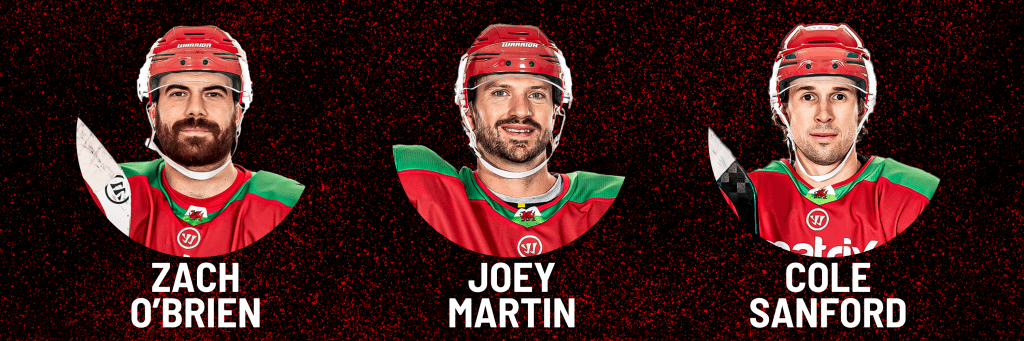
This line started when Sanford rejoined following a decision to leave Germany and look for a more comfortable environment, it paid dividends, however, they weren’t always the top line.
They started mostly as the third, with the current third as the F2 group – however, since the injury spell a few weeks ago, they were almost forced into it, despite the calls from analysts such as myself.
Together, they produce. Both at 5v5 and on the power play. So here is how they shape up as a unit;
Across the league, they have played together only three times (in terms of official line allocation) twice as the third unit. O’Brien and Sanford have lined up together 7 times, so each game since Sanford returned.
In that time, they have iced together 87.5% of all league GP, whilst Martin just 37.5% and only one third as a top line.
You might think, well this is evidence they aren’t the top line – however, their output disproves this with absolute certainty.
At both EVS (Even Strength) and on the PP (Power play) this line as put up some important and consistent contributions, be it from goals, assists, or even just part of the line offence that got the goods.
O’Brien for example has all of his assists on the PP and 40% of his goals also on the PP. Every converted PP he has been a net contributor thus far, with 33.3% of the all PPG’s directly from him.
This would make him 100% on the PP. Martin and Sanford each have a PPG, taking the overall line contribution on the PP to 66.6%,
Together, they have combined for 25 points, two more than the current F3 and +16 compared to the previous F1 line.
So, obviously this makes sense that net contributors are given the greater role and ice time.
Another factor to look at, is that whilst Devils have won all but one of their league games so far, the one they didn’t, O’Brien wasn’t on the scoresheet. Also, with each W the team put up 3 or more goals.
34.5% of all goals scored so far has come directly from this line combination, the former F1 unit produced a combined 13.8% of goals scored so far for a direct comparison.
Second Forward Line (F2)
Now, the way lines are used are generally specific to the system the coaches want to implement. Do they compliment a game flow where creativity for more chances on goal are generated?
Does this line develop a natural forecheck and chaotic style of offense, that is disruptive and creates more turnovers, thus, creating gaps and outlets for the more skilled players to recycle/recover the puck and put the goalie under pressure?
So far, this has been the start, with the latter chosen over the former. Skate hard, hit harder, wear them down, send in the specialists to find the sweet spots and finish them off.
It works to a point. At some stage, you need your most productive players to take up the greater minutes, but shuffling the set up where some bigger size is needed or to reward a player here or there for their contribution should also factor in.
For a long time, the old saying has been, ‘there is no plan B‘ – that hasn’t been the case at all under coach Russell. There are multiple selections and methods used, most of the time, they work!
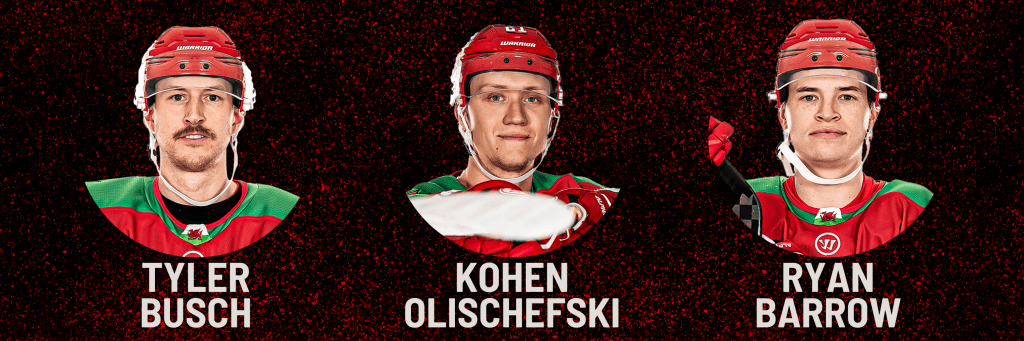
The F2 line I have selected as the current set up reflects what is needed to balance the lines, particularly how the last few games have gone.
They started as the top line, rewarded for excellent effort and great chemistry, which the latter is the single most important aspect for any line in hockey.
Barrow and Olischefski know each other well, went to college together and it shows. Barrow also has a similar forecheck style to Busch, who is great at face-offs and can be a nuisance around the net and the greasy areas.
Olischefski is not afraid to get physical and can find twine from all angles. The options and potential for more are endless, particularly as it is a young, hungry and driven unit.
NB; I really wish Hits were recorded officially (how are they not included in official game stats?!) – This variable would help to show how truly physical players and teams would be, which would also help with more advanced analytics.
This line would likely be the most highest scoring in this area, with the 4th line, the ‘Benergy Line’ just behind them.
So far, this unit has had the lions share of the top line ice time, bar a few games where injuries have forced a reshuffle.
62.5% of the league games so far has seen this line as the top, however, productivity has been thin. Just three games they have contributed, two as a full line. In those games, they were the top.
So, 40% of the time they started on F1, they contributed, however, 25% overall when considered as a top group.
A huge contrast to the ‘Goat Line’, where every game they have had an impact on the scoresheet. The very last game played, this line was split due to a late scratch to Martin, scoring on both power plays, engineered and directed by O’brien.
This late shuffle saw a middle line of Olischefski and Barrow greatly utilised as utility options, which was addressed a few articles ago, to provide further depth options. It was fun to see and observe.
The reason why I have prioritised the ‘Goat Line’ over the one that has started the most as the F1 unit, is due to production. Whilst it makes sense having stacked top sixes, it is good to have balance for both ends of the spectrum overall.
One unit that hits big, the other scores big. A constant cycle, that should be efficient and constant, continuous and reliant. I can see this is where the lines would roughly look like overall across the season and this top 6 hasn’t even seen Hunter Shinkaruk ice a full game yet.
Let that sink in.
Third Forward Line (F3)
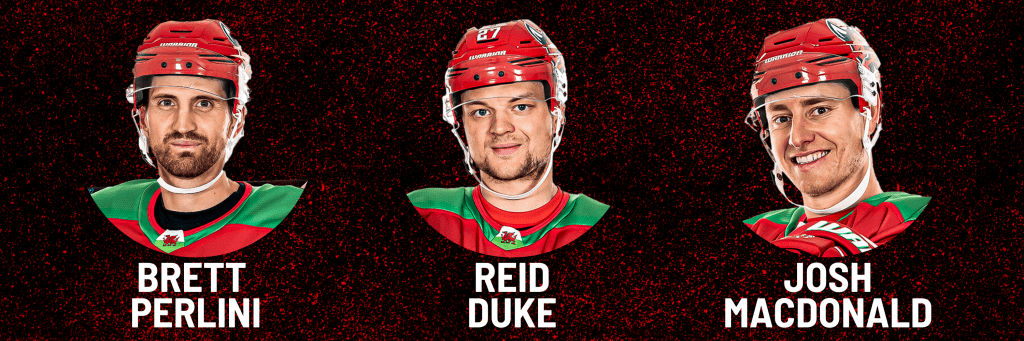
The third line has been a constant presence since day one, that has been loaded with speed, silky mitts, great passing, good defensive work and memorable moments in front of net.
From the experience of Perlini, to the dazzling stick handling of MacDonald and of course the dynamic and ferocious tempo driven, hard nosed play of Duke, they are creative, combative and contribute in all areas.
Again, this is a unit that could easily be F1, but having that balanced split as mentioned earlier just demonstrates the scoring depth already picked up by hockey fans, club and beyond.
The majority of this line has spent time on the F2 this season, but with mixed success. Only when all three were a unit, have we seen them cook.
As a unit, they combined for 23 points so far in 8GP, just two shy of the projected/proposed F1. So, why not put these guys as F2 proper, like for the most part, they have been?
Balance.
You could stack up the top 6, which has brought a dividend of 48 points in 8GP, so 8 points per player, making that a one PPG pace overall. Then, there is a huge drop off for the rest of the forwards group overall, which limits scoring depth.
It also took just 5 game weeks for a real injury crisis to occur, on top of those that were already out medium term, that forced a reshuffle.
Ideally you would want your most skilled forwards that produce each game, during all situations, for simplicity, EVS and PP.
The chosen ‘Goat Line’ fills this role. The F2 line then should be the less productive, but highly coachable, two-way ‘play drivers’. This is why the chosen ‘Havoc Line’ slots in.
Which brings us to this current F3.
This line has generally phased into the third naturally, as a season opens up, you get to see the impact players have on certain lines with certain line mates. There is no denying a high chemistry here.
Since the mini injury crisis at game week 4, this line has cooked together, scoring across the deck in each game since, going for 14 points combined, making 60.1% of all their scoring on a bonafide line.
This helps to adjust to each team and opposing line, all of the top 9 are interchangeable. Devils haven’t enjoyed this for a very long time.
The scoring chart runs deep, even at this early point in the season before the fixtures start to amass heavy and relentlessly.
For the line depth chart, having a third line as potent as the top scoring helps to efficiently rotate options, meaning that teams face high intensity physical shifts, then just as high in tempo, more dynamic puck movement, then back to the physicality, then back to the sharp shooting.
In essence, it is relentless. Pete. Russell. Hockey.
In reality, when you can have a top 6 that is nearly identical, of course they can’t all fit on the same line at the same time, but you also don’t want them all out for the same periods of time, particularly when special teams get used.
Then, when a spot opens up, role dependent, there is a usual ‘go-too’ to fill it, opening up other opportunities elsewhere, usually by injury, sometimes suspension.
This is why we have seen some movement already with Busch and Perlini, moving up and down each line, bringing that physical factor to the unit, allowing a shooter and puck carrier to do their thing.
Fourth Forward Line (F4)

The final forward group is perhaps the most consistent, as it comprises those with the least TOI overall, a unit of gritty players, grinders and often gets utilised on the PK.
This special team helps to inflate TOI overall per player, but over the last few seasons, this has been a less effective group, so with the newer players on the roster, this might get some tweaks throughout the season.
This line is also one of the most physical, which in this teams’ case, tends to be true. Duggan likes to play a hard two-way game, Davies gets to those greasy areas and knows how to pinch in and turn pucks over, then you have Brandt. Enough said here.
Also, they feature heavily as mentioned on the PK, where they like to break down zone entries, get loose pucks and battle to get the zone clear.
Often Tyler Busch might feature on this line, as his style compliments the rough and tumble aspect to what has become affectionately known as the ‘Benergy Line’.
For short (literally) bursts, they will cause chaos, disrupt the flow of their opposition and in some cases, drive their opponents to anger.
The biggest caveat is that Brandt was out on the IR list for the first few weeks, along with Carruth and Skinkaruk.
Since his return, it has helped to level line selection, however, some dubious calls has greatly limited his TOI.
As a unit, they have combined for 6 points, so if there was a double tap for the top 6, then the bottom 6 split would leave a massive gap in production. A differential of -32 compared to the strongest group of 6, this is why splitting the talent usually becomes the best option.
Blue Liners
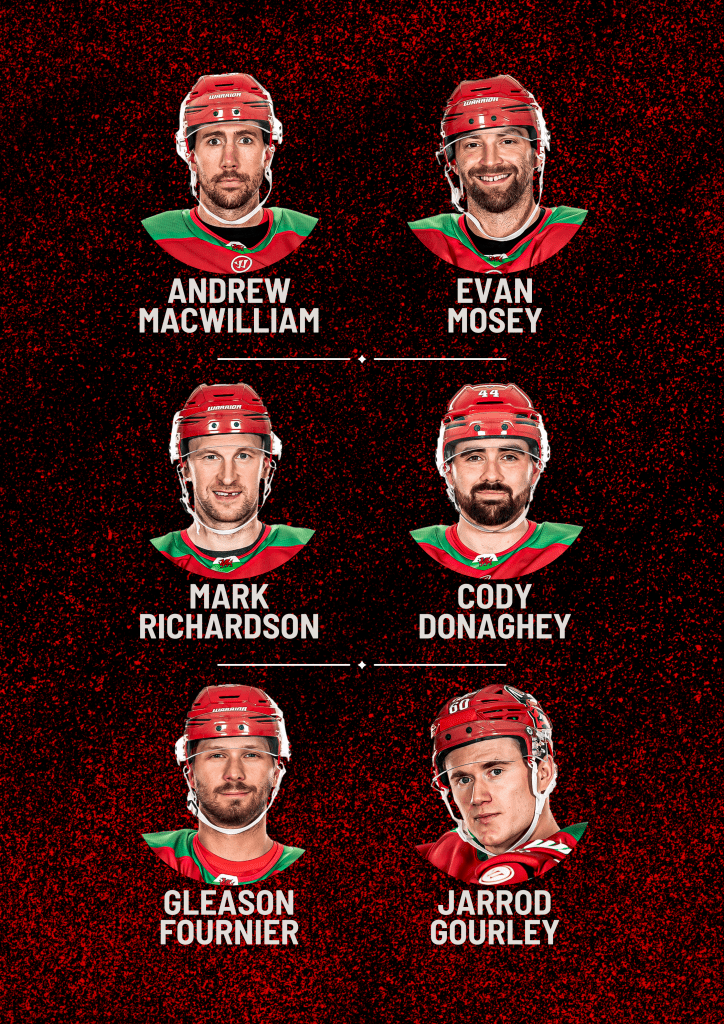
The defensive pairings usually comprise as your Top 2, Top 4, Top 6 and when the squad allows, Depth players. In this league, most teams are lucky to roll a full set of 6 defensemen, most nights it could be a 5 D squad. After all, this isn’t the NHL, clubs do what they can, with what they have at their disposal.
Naturally, the blue liners would want a partner with the opposite handedness, but this isn’t the be all to end all, nor is it conducive to success and good match making.
In terms of TOI, the biggest shareholders in this statistic are the top 2 D. Last season, Marcus Crawford and Cody Donaghey lead in these areas across all EIHL comps.
The third pair usually comprises of the more physical, stay at home players, which should be a shut down line, one for transition and to control the pace of a game that is either getting away from the team or that game needs a spark.
Previously this was the role of Mark Louis and Josh Batch. Of course, these kind of pairings sacrifice mobility, speed and offensive output and often amount to a lot of giveaways, turnovers and collapse around the net.
To my observations of the Coach Russell style, he prefers to have a mix on each line, as the role of defence is not strictly to the men on the blue line, this is a line and therefore team responsibility. He expects defense from his forwards as much as the D.
Across the 8GP in league action so far, MacWilliam has been on the top pair for 62.5% of the games, with a knock picked up vs Giants seeing him miss a game.
The early games were an obvious time of finding the lines, as the pre-season wasn’t much of a chance to do this, thanks to international commitments for players and staff at the club,
Fournier and Richardson have partnered the most, across the middle and third pairing for 75% of league GP so far. This is a natural pairing that should give vibes reminiscent of when Andrew Hotham paired with the Captain.
Evan Mosey was nearly an after thought, as he has been used as a forward and on D, but also spent a chunk of time out with an injury.
This however is probably the worst caveat for his team, but also the best. Where do you play him? A natural two way player, not just for the 200ft sheet of ice but positionally.
This is why I preferred him as a top line pair with MacWilliam. He complimented the back to back EIHL DOTY Crawford in this role, but as his previous partner was a natural OFD, contributing massively to points each night, MacWilliam offers that reliable cushion as the stay at home option.
This means that Mosey can skate around finding passes, splitting structures and adding to the scoring depth.
Six of the 7 D we have when in a full, healthy system have featured on the top line, the other blue liner matching MacWilliam on the top deck is Jarrod Gourley, perhaps the most underrated skater on the roster so far.
He has also iced 5 times as a first line pair, each time with MacWilliam, Its a strong pairing physically, where both can find a great outlet pass, however, for scoring contribution it is somewhat limited.
Gourley did however get the opening goal away to Giants in their only league loss so far this season.
Despite the pairing of Fournier and Richardson, I find the matching of Fournier and Gourley to have an added dynamic, because both are strong defensively and can contribute the other end. Also, they have a very high hockey IQ.
Age and Mobility is a genuine element for this group, Fournier can skate, Gourley can back check just as quickly as Mosey. This limits danger on turnovers and breakaways against.
The options available on D are perhaps the most expansive the club has seen for quite a long time. No longer are players brought in and it is profoundly obvious where they slot in. Match ups vs teams can be found, adapted to and capitalised on.
This opens up the selection process to requirement not necessity, unless there are further injuries or suspensions. Even last season, Justin Crandall helped out on D. This year, there are 6 to choose from, plus Mosey as a natural two way.
In total, the blue liners have put up 21 points combined. Naturally there have been some missed games, however from the pairings suggested it reverts the dynamic of top end scorers and bottom end shut down players.
The pairings offer 3, 7, 10 points respectively. The missing point would be Josh Batch. This isn’t a dig at the player or his game, however for production in the league so far, MacWilliam has the same, but offers a stronger presence and role.
The system I have approached is a dynamic of speed, age, skill and the mix of one goes forward, the other stays back. This allows the forward units to activate more as there is enough defensive back check to help that D-man who would push up the play and pinch naturally.
Also, they can be mixed and either evened out for scoring/production chances or completely bolster top down, instead of bottom up (in terms of points).
It has been a slow start for him but the prodigal son that is Gleason Fournier has put up 6 points, the most for the blue line group, with Richardson and Gourley at 4 each.
They have all featured across each defensive unit and line, which backs up how they can be paired as above, as they have contributed to 66.67% of all the points produced by the entire blue line pack.
So far this season, it is a stark contrast to who sits in the top three for scorers. Usually at least one blue liner features, however, the forwards are doing their work, allowing the D to support on the blue line or crush opponents into the boards.
 HockeySteve Stats & Insights